AI engineer is the most searched technical job title in India in 2025. LinkedIn shows 340% year-over-year growth in postings. Salaries at senior levels rival those in data science and full-stack development. And the skill gap between what companies need and what the talent market provides is wider than in almost any other technical discipline.
That gap is an opportunity — but only if you build the right skills. This guide is based on five years of training developers at companies across India and watching who gets hired, what they actually know, and how they got there. It will tell you what works and what does not.
What Is an AI Engineer?
An AI engineer builds production software that uses large language models (LLMs) as components. This includes:
- RAG systems — AI applications that answer questions using your company's own data
- AI agents — autonomous systems that complete multi-step tasks using tools and reasoning
- LLM-powered APIs — services that expose AI capabilities to other applications
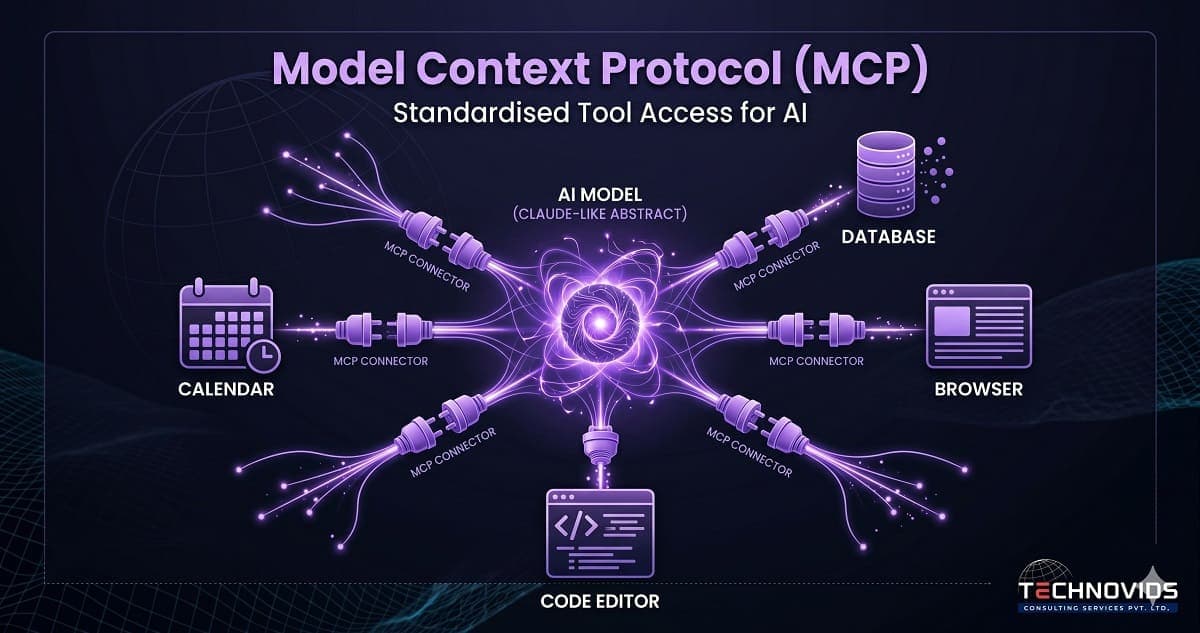
- AI integrations — connecting AI models to existing enterprise software via protocols like MCP
An AI engineer is not a data scientist (who builds predictive models from data), a machine learning engineer (who trains and optimises ML models), or a prompt engineer (who optimises prompts for specific tasks). These are distinct roles. AI engineering is software engineering with LLMs as a primary component — it requires strong programming fundamentals, system design knowledge, and deep familiarity with LLM frameworks.
The AI Engineering Market in India
The demand is real and concentrated in specific sectors. Based on the profiles of developers we train:
Product companies (SaaS, fintech, e-commerce) are building AI-native features and need engineers who can ship RAG pipelines and agents alongside existing product code. These are typically 2–5 person AI teams embedded in engineering organisations of 50–500.
IT services companies are building AI capability for both internal use and client delivery. The demand here is for engineers who can lead AI implementation projects — which requires both technical depth and the ability to communicate with business stakeholders.
Enterprises with internal AI teams (banking, insurance, manufacturing, healthcare) are building internal tools: knowledge management systems, process automation agents, document processing pipelines. These roles are often called "AI lead" or "AI architect" and command premium salaries.
AI-native startups are building products with AI as a core feature. They need engineers who can move fast, make good architecture decisions under uncertainty, and ship.
Salary ranges at current market rates in India: ₹18–35 LPA for engineers with 2–4 years of experience and demonstrable production AI projects; ₹35–65 LPA for senior engineers who can own end-to-end AI system design and delivery.
Skills You Actually Need
Based on what companies are actually testing in interviews and what the role actually requires day-to-day:
Python (intermediate to advanced): Not data science Python. Software engineering Python — classes, async/await, API design, error handling, testing, Docker. If you cannot write a clean FastAPI service, you are not ready to productionise AI systems.
LLM API fundamentals: How to call OpenAI, Anthropic, and Google APIs. How to structure system prompts. How structured output works. How to count tokens and manage costs. How streaming works. This is foundational — everything else builds on it.
RAG architecture and implementation: How to build a complete RAG pipeline — chunking, embedding, vector database, retrieval, reranking, generation. How to evaluate retrieval quality. How to debug retrieval failures. This is the core skill of AI engineering in 2025.
LangChain and LlamaIndex: The dominant frameworks for RAG and LLM application development. You need to be able to build with both and explain the trade-offs.
LangGraph for agents: The standard for production agentic AI. You need to understand graph-based state machines, tool calling, and human-in-the-loop patterns.
System design for AI: How to architect AI systems that are reliable, observable, and maintainable. How to handle LLM failure modes. How to monitor AI applications in production. How to manage costs at scale.
What You Do Not Need (Counterintuitive)
Several things that are commonly recommended for "AI careers" are not required for AI engineering, and pursuing them first can add 12–18 months to your timeline unnecessarily:
You do not need a machine learning degree or deep ML theory. AI engineers use pre-trained models via APIs. Understanding transformer architecture at a mathematical level is not required to build RAG systems or agents. You need to understand the inputs and outputs, not the matrix multiplications inside.
You do not need to know how to train models. Fine-tuning is occasionally useful and occasionally relevant. It is not a foundational AI engineering skill in 2025 — it is an advanced, specialised skill used in a minority of production scenarios.
You do not need to learn TensorFlow or PyTorch first. These are model training frameworks. AI engineers consume model outputs via APIs. Unless you are specifically moving toward ML engineering (a different career path), this is a detour.
You do not need a data science background. Data science requires statistics, hypothesis testing, and ML model evaluation. AI engineering requires software engineering and LLM framework expertise. They are adjacent but distinct.
The Learning Path That Works
Stage 1 — Python foundations (2–4 weeks if needed): Functions, classes, API calls, error handling, environment variables, basic async. Skip if you already build backend services in Python.
Stage 2 — LLM API fundamentals (2–3 weeks): Call OpenAI and Claude APIs directly. Build structured output extractors. Build a simple chatbot with conversation memory. Understand token costs.
Stage 3 — RAG (4–6 weeks): Build a complete RAG pipeline over your own documents. Learn ChromaDB or Pinecone. Learn LangChain and LlamaIndex. Build a RAGAS evaluation harness. This is the most important stage — spend time on it.
Stage 4 — Agents with LangGraph (4–5 weeks): Build a research agent. Build a tool-calling agent. Build a multi-step workflow with human checkpoints. Understand state persistence.
Stage 5 — MCP (2–3 weeks): Build a custom MCP server. Connect it to Claude Desktop. Understand the security and access control model.
Stage 6 — Production deployment (3–4 weeks): FastAPI, Docker, async performance, monitoring, cost management, error handling. Deploy something real.
The 4 Most Common Mistakes
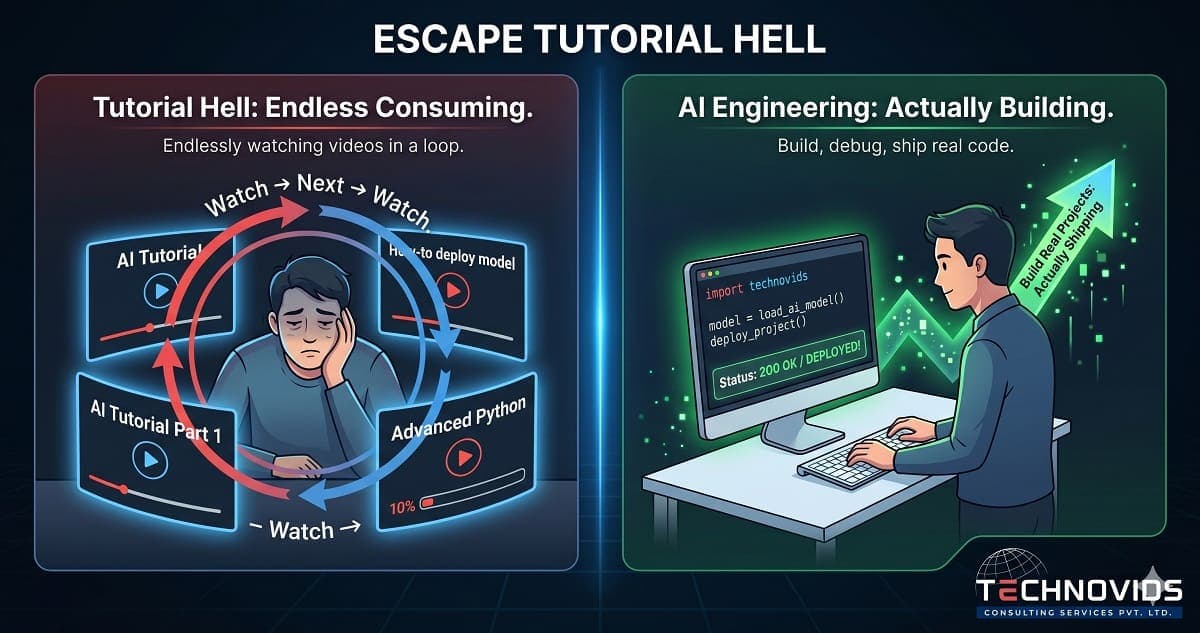
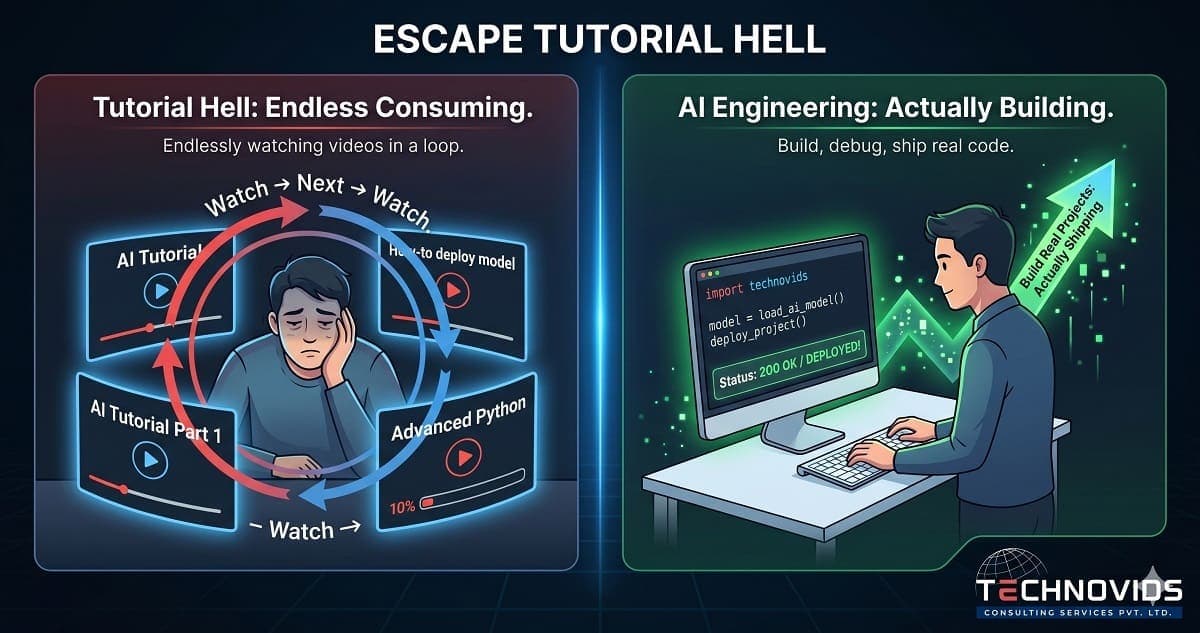
Tutorial hell: Consuming educational content indefinitely without shipping anything real. The exit is imposing a no-tutorial rule on at least one project per stage. See our full post on escaping tutorial hell in AI engineering.
Starting too advanced: Jumping to agents before understanding RAG. Trying to build a multi-agent system before being able to debug a single tool call. The stages exist for a reason — each one builds the foundations for the next.
Skipping evaluation: Building pipelines and deploying them without measuring retrieval quality or generation faithfulness. You cannot improve what you cannot measure. RAGAS is not optional — it is the difference between knowing your system works and hoping it does.
Underestimating production requirements: Getting a demo working and assuming it is ready to ship. Production AI systems need error handling, monitoring, cost controls, and graceful degradation. Most tutorials stop at the demo. Real engineering starts there.
Realistic Timelines
With consistent effort (10–15 hours per week), a developer with solid Python skills reaches Stage 6 in 6–9 months of self-directed learning. The bottleneck is always the same: getting unstuck when something breaks in an unexpected way. Without feedback, a 2-hour debugging session can become a 2-week rabbit hole.
With structured mentorship, the same developer reaches Stage 6 in 3–4 months. The compression comes entirely from eliminating the stuck-for-days-on-a-problem loop. When you have a mentor watching your screen, you get unstuck in the same session.
With a focused intensive training programme (like a 5-day corporate course), a team of developers reaches Stages 2–6 in a week of dedicated time. This is only practical in a team context where a full work week can be dedicated to training.
Your Next Steps
If you are an individual developer in India: our detailed AI engineering roadmap with milestones maps the full path with concrete projects to validate each stage. If you want to accelerate, the 1:1 AI Engineering Mentorship compresses the 9-month solo path to 3 months with dedicated expert support.
If you are an engineering manager or L&D lead looking to upskill a team: the Production AI Engineering corporate training takes developer teams from LLM basics to production RAG and agents in 5 days, with all five portfolio projects built in your own codebase by the end.